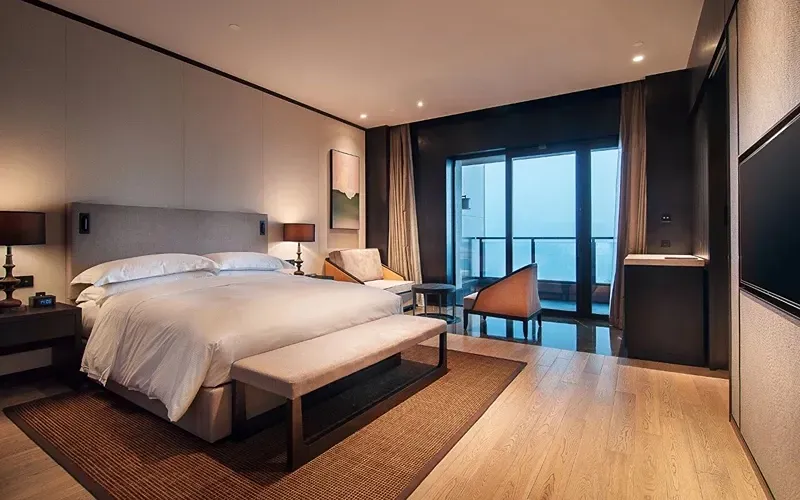
There’s a quiet shift happening in the bedrooms we design. After a decade of polished concrete, wide-plank oak, and flat-weave rugs over hard floors, clients are asking for something their feet can sink into. The bedroom is where this tactile renaissance is happening first.
For us, that’s both opportunity and question. The opportunity: a surface that genuinely changes how a room feels at 6 a.m. and 11 p.m. It softens acoustics. It holds warmth. It visually anchors a bed. The question: how do we do that without slipping back into the dated beige wall-to-wall so many clients grew up with?
The 2026 answer sits in three things. A richer, earthier color palette. Bio-synthetic and traceable materials. A renewed love of texture for its own sake. Let’s walk through what to specify, what to ask suppliers, and what to leave behind.
Why Bedroom Carpets Are Having a Moment in 2026
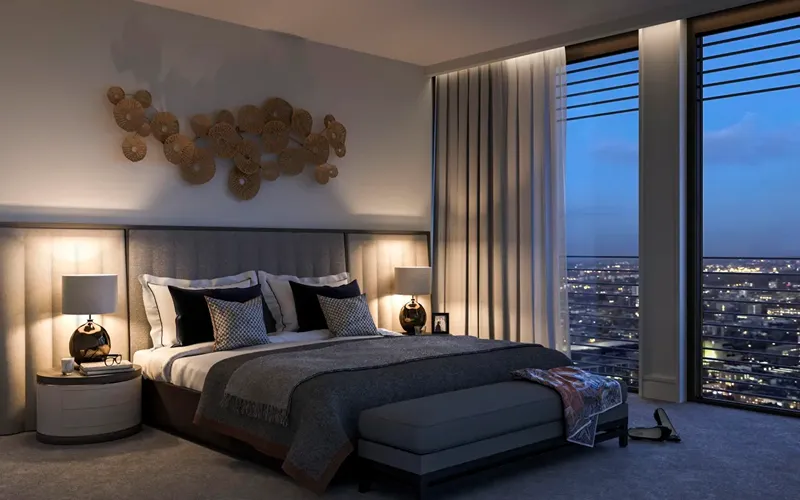
The pendulum has swung. We’re coming out of a decade of hard-surface maximalism — polished plaster, draped windows, long-napped velvets and bouclés. The mood has moved from crisp and cool to soft and grounded. Bedrooms are where clients feel safe enough to go all the way.
Clients who used to ask about VOCs in paint now ask about underfoot comfort. About room acoustics. About thermal regulation. A bedroom with a quality carpet is measurably quieter. It holds heat in winter. It creates a softer acoustic envelope that many sleep researchers link to deeper rest.
Pinterest and Instagram feeds are saturated with “soft maximalism” — layered rugs, tonal color stories, the kind of tactile depth that only a soft floor delivers. Clients arrive at design meetings with saved images of bedrooms where the floor is the protagonist, not the backdrop.
The material story has caught up, too. For years, designers hesitated on bedroom carpet because the supply chain was opaque and the environmental story was weak. That’s changed. Wool certifications are more transparent. Recycled PET and bio-based fibers have improved in hand and longevity. Several mills now offer take-back programs. The conversation has shifted from “is carpet sustainable?” to “which carpet is most sustainable?” — a much better place to start.
The bedroom is the room where clients give themselves permission to be comfortable. Carpet is the surface that delivers that permission.
Color Stories: The 2026 Bedroom Carpet Palette
If the 2010s were cool greys and the early 2020s were greige fatigue, 2026 is the year of warm, earthy, food-adjacent color. The bedroom carpet palette now reads like a chef’s pantry — terracotta, oat, sage, olive, aubergine, paprika, ink. These are colors that feel good in low morning light. They feel even better in candle-lit evenings. Which is exactly the lighting cycle a bedroom actually lives in.
Warm Terracotta and Dusty Clay
Terracotta has moved from accent to anchor. A carpet in warm terracotta or dusty clay creates instant grounding, especially in rooms with white or plaster walls and natural timber furniture. It pairs naturally with Japandi and modern traditional schemes. It reads as “warm Mediterranean” when paired with linen bedding in undyed oatmeal. Specify it in a low-luster wool or wool-silk blend to avoid the bright, commercial finish cheaper synthetic terracotta can produce.
Sage, Olive, and Forest Greens
Greens are still the most-requested carpet color family in 2026, but the tone has shifted from cool eucalyptus to warmer sage and olive. Sage is the new neutral. It sits comfortably against cream, walnut, and brass. It brings the outside in without resorting to botanical prints. For clients nervous about a fully green carpet, a tonal striae in sage and oat is a softer entry point that still feels current.
Moody Aubergine and Ink Navy
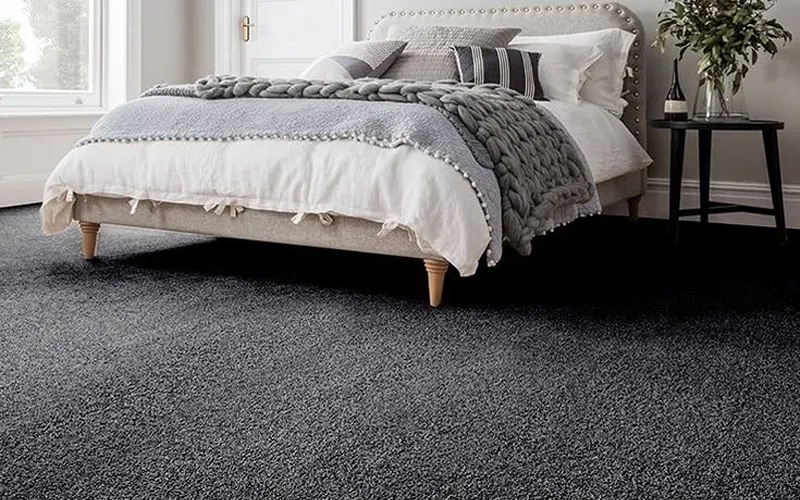
For clients willing to commit, deep aubergine and ink navy carpets are the most under-used opportunity of 2026. A dark carpet in a bedroom is counterintuitively calming. It visually lowers the room’s energy. It hides soil at the bedside. It lets lighter bedding and artwork pop. Aubergine pairs beautifully with rose gold and warm brass. Ink navy reads as a contemporary alternative to charcoal and pairs with virtually any accent color.
Oat, Undyed, and “Naked Wool” Naturals
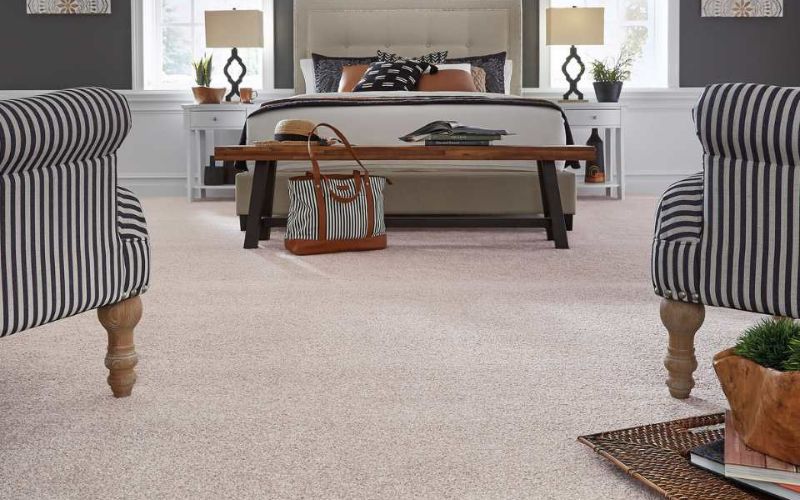
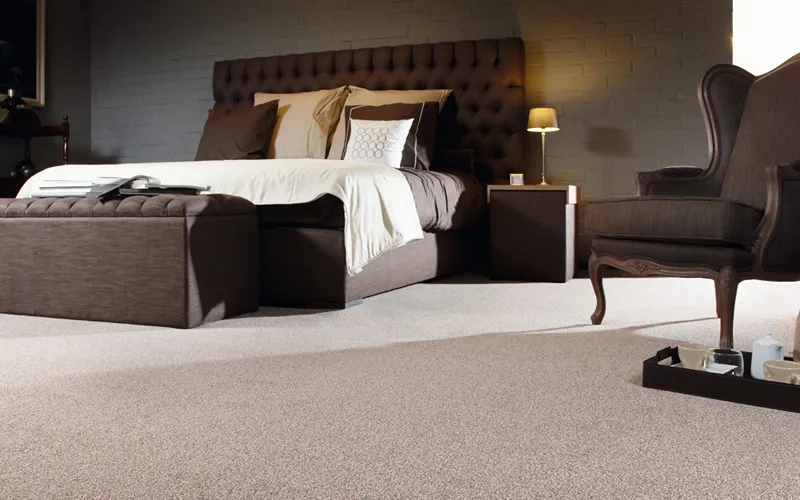
The most quietly luxurious carpet trend of 2026 is the undyed natural. These carpets use the actual color of the fleece — oat, wheat, fawn, soft brown — and the variation is the point. A natural wool carpet with subtle tonal shifts reads as honest, tactile, and quietly expensive. It also sidesteps the dye-lot anxiety that plagues synthetic beige carpets: variation is part of the aesthetic, not a defect.
Materials and Sustainability: What to Specify, What to Ask
Material selection in 2026 isn’t a binary of “natural good, synthetic bad.” The honest picture is more nuanced. Every material has trade-offs across softness, durability, cleanability, embodied carbon, and end-of-life. Designers who can speak to those trade-offs fluently will earn client trust and specify with confidence.
Here’s the other thing: the sustainability story around bedroom carpets has matured. You can’t get away with “wool is natural” anymore. Clients ask pointed questions about carbon footprint, water use, chemical finishes, end-of-life pathways. The supply chain has caught up. Designers who learn the vocabulary will find genuinely strong materials to specify.
So let’s cover both at once. Here’s how the major materials stack up, with the certifications and supplier questions woven in.
Pure New Zealand Wool — Still the Gold Standard
Still the best all-round choice for bedrooms. New Zealand wool is naturally crimpy, which gives it exceptional resilience and a luxurious hand. It’s naturally flame-resistant without chemical additives. It absorbs indoor VOCs. It holds its color for decades. Specify a wool carpet with the Woolmark or Woolmark Blend certification, and ask suppliers for country-of-origin traceability — reputable mills will provide it. Trade-off: cost, and a higher learning curve for cleaning. For primary bedrooms where comfort and longevity matter most, wool is the easiest material to defend.
Wool-Silk and Wool-Viscose Blends — The Quiet Luxury Move
When the brief calls for understated elegance, wool-silk and wool-viscose blends are the answer. A 90/10 wool-silk blend produces a carpet with subtle tonal shimmer that reads as quietly luxurious — perfect for primary suites and guest bedrooms. Viscose (often marketed as “art silk”) offers a similar look at lower cost but is less durable. Reserve it for low-traffic bedrooms. Avoid it entirely in children’s rooms where spills are inevitable.
TENCEL and Lyocell — The Most Exciting Story of 2026
Made from responsibly sourced wood pulp in a closed-loop process, these fibers offer silk-like hand, excellent moisture management, and credible sustainability claims. Several European mills now produce lyocell-blend broadloom that performs well in bedrooms. Soft. Breathable. Biodegradable at end of life. Lead times are longer than wool, so specify early in the project schedule.
Recycled PET and Bio-Based PLA — The Budget-Sustainable Option
Recycled PET (from post-consumer plastic bottles) has matured significantly. The latest generation of PET carpets has overcome the early “scratchy hand” and “rapid crushing” problems. Bio-based PLA fibers, derived from sugar cane and corn, are emerging as a credible alternative with a smaller carbon footprint than virgin synthetics. Neither is as soft or as long-lived as quality wool, but both are legitimate options for budget-conscious clients who still want a sustainability story. Set realistic lifespan expectations — 8–12 years in a primary bedroom is reasonable.
Natural Fiber Blends — Sisal, Jute, Seagrass
Natural fiber carpets are still best used as a layered element. A sisal or jute rug over a hard floor. Or a wool broadloom with a natural-fiber runner at the bedside. Pure sisal and jute are too coarse for comfortable barefoot use across an entire bedroom. But blends that combine wool with 10–20 percent sisal offer the visual texture of natural fiber with the softness a bedroom demands.
The Certifications Worth Specifying
When clients ask the sustainability question, here’s what to look for. Woolmark and Woolmark Blend for wool content and quality. GOTS (Global Organic Textile Standard) for organic natural fibers. Cradle to Cradle Certified for whole-product sustainability across material health, recyclability, and social fairness. GREENGUARD Gold for low VOC emissions — particularly important in bedrooms where sleep air quality is non-negotiable. A carpet carrying two or three of these marks is one you can defend with confidence.
Low-VOC Adhesives and Take-Back Programs
The carpet itself is only half the indoor air quality story. The adhesive used to install it can off-gas for weeks. Specify low-VOC or VOC-free adhesives for any glued-down installation. Consider a stretch-in installation for wool carpets where the subfloor allows. For new builds and full renovations, ventilate the bedroom for 72 hours minimum after installation before the client sleeps in the room.
On end-of-life, several European mills and a growing number of US suppliers now offer genuine take-back programs. The carpet is collected at end of life and either recycled into new yarn or safely composted for pure wool. Ask suppliers explicitly: “What happens to this carpet when the client is done with it?” If the answer is “landfill,” weigh whether the material’s other benefits outweigh that end-of-life cost. For pure wool carpets, the answer should always include composting or recycling pathways.
One last word on greenwashing. A supplier claiming “sustainable” without third-party certification is making a marketing statement, not a verifiable one. Ask for documentation. Certificates. Chain-of-custody records. Lifecycle assessment data. Reputable mills provide all of this willingly. Suppliers who hesitate are worth interrogating further. We have a professional responsibility to specify materials whose claims can be substantiated.
Pattern, Pile and Plush: Textural Trends for 2026
If color is the what of 2026 bedroom carpets, texture is the how. This year’s most exciting specifications aren’t loud patterns. They’re quietly sophisticated textural plays — cut-and-loop geometries, ombré striaes, deep plush pile, and the rediscovery of the Berber loop as a designer move rather than a builder-grade default. Texture, more than pattern, gives a bedroom carpet its sensory depth.
Deep Plush Pile (60mm and Beyond)
Deep plush pile is having a quiet revival. Not the dense shags of the 1970s. A more refined long-pile finish in 50–70mm lengths, primarily in wool and wool-silk blends. The foot-feel is extraordinary. The acoustic absorption is excellent. The visual softness makes a bed feel like it is floating on a cloud. Specify a quality underlay (10mm or thicker PU foam) to support the pile and prevent premature crushing. Reserve deep plush for primary bedrooms and guest rooms — it’s too indulgent for high-traffic spaces.
Cut-and-Loop Geometries
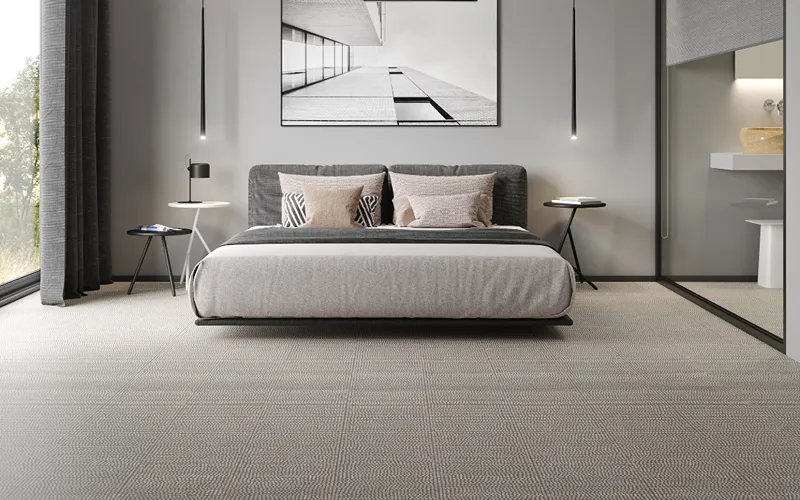
Cut-and-loop construction — where the loom alternates between cut pile and loop pile to create a patterned surface — has been quietly reimagined by several European mills. The new geometries are tonal rather than contrasty. Subtle diamonds, oversized ribs, organic “wave” patterns in a single color. The result reads as solid from across the room but reveals textural interest up close. An excellent option for clients who want pattern without committing to a printed design.
Tonal Striae and Ombré Effects
Tonal striae — carpets where the color subtly shifts across the surface — are the most-requested textural treatment of 2026. They mimic the natural variation of undyed wool. They work in any color family. They hide soil brilliantly. Ombré carpets that fade from one tone to another (sage to oat, navy to ink, clay to cream) are a bolder move that works in contemporary schemes with clean-lined furniture. Specify striae from mills that dye their own yarn; the effect depends on consistent dye-lot control.
Berber Loops, Revisited
The Berber loop has shaken off its builder-grade reputation. The new Berber is finer, denser, specified in sophisticated palettes — soft greys, warm naturals, deep ink. A high-density loop carpet is exceptionally durable. It holds its appearance for decades. It’s the right choice for children’s bedrooms and guest rooms where the practical brief outweighs the indulgent one. Specify a 100 percent wool Berber with a tight gauge for the best combination of durability and design.
Broadloom with Layered Rugs
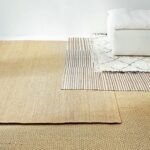
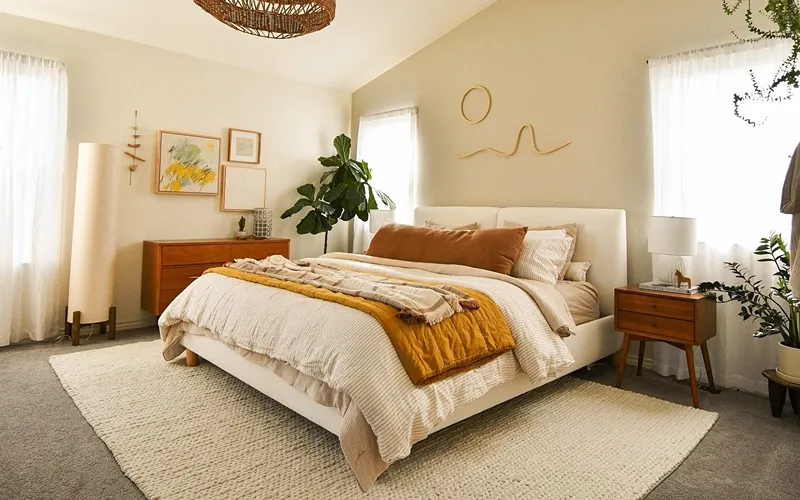
An increasingly popular specification is wall-to-wall broadloom in a neutral tone — usually undyed natural or soft oat — with a smaller patterned or textured rug layered at the bedside. This gives the comfort of carpet across the whole room and the design flexibility of a rug as an accent. It also allows designers to swap the accent rug seasonally or as trends evolve, extending the visual life of the underlying broadloom.
Specifying Like a Pro
Specification is where the design conversation meets the supply chain. A beautiful carpet specified with the wrong underlay, the wrong installation method, or without confirming lead times can sink an otherwise excellent bedroom scheme. Here’s what to get right.
Underlay Is Half the Carpet
The single most under-specified element in a bedroom carpet project is the underlay. A quality carpet installed over a thin, cheap underlay will feel hard underfoot and crush within two years. Specify a 10mm or thicker PU foam underlay for primary bedrooms (12mm for premium projects). Consider a rubber crumb underlay for sustainability-focused clients. The underlay contributes roughly 50 percent of the perceived softness of the finished floor. It’s not the place to save budget.
Wall-to-Wall vs. Room-Size Rug Math
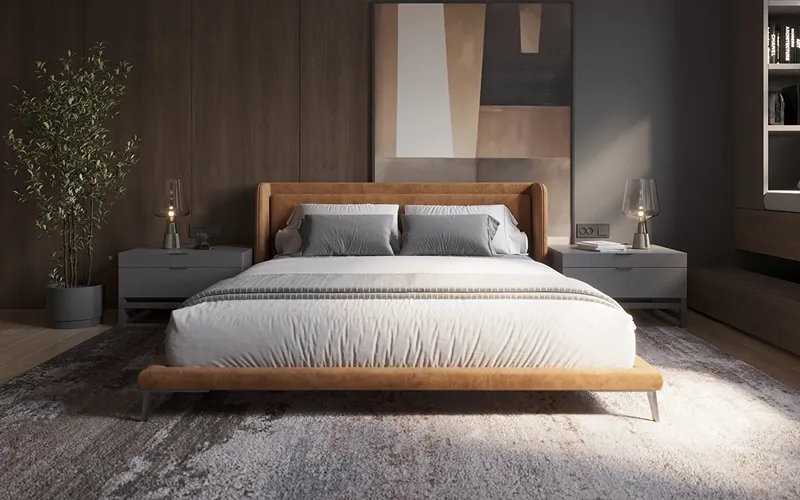
For wall-to-wall installations, allow a 100mm margin around the room perimeter for trimming and edge finishing. For room-size rugs layered over hard floors, the right size sits 200–300mm under the bed on all visible sides — small enough to leave a hard-floor border, large enough to anchor the bed and bedside tables. A rug that’s too small is the single most common mistake in layered bedroom schemes. When in doubt, go larger.
Transitions, Binding, and Serging
Plan transitions from carpeted bedroom to hard-floor hallway early. A simple aluminum threshold strip works but is visually clumsy. A custom wood transition, milled to match the adjacent floor, is the designer move. Where carpet meets tile in an en-suite, specify a low-profile transition that allows for a small height differential without creating a trip hazard — the carpet should finish 3–5mm below the tile surface.
For rugs cut from broadloom, the edge finish matters as much as the carpet itself. Custom binding in a cotton or leather tape, matched or contrasted to the carpet color, elevates the finished piece. Serging — a hand-stitched overcast edge — is the more refined option for wool carpets and reads as couture. Allow two to three weeks for custom edge work on bespoke orders.
Sample Protocol and Lead Times
Always order a 300x300mm minimum sample for client approval, and a separate cutting for the project file. Lighting in the showroom is never the same as lighting in the bedroom. Encourage the client to live with the sample for 48 hours. View it in morning light, evening light, and lamplight. For bespoke and European-mill carpets, plan for 8–14 week lead times. Never specify a long-lead carpet as the final element of a project schedule.
Questions to Ask Every Supplier
- Country of origin: where was the yarn spun and the carpet woven?
- Certifications: Woolmark, GOTS, Cradle to Cradle, GREENGUARD Gold?
- Take-back program: does the mill accept the carpet back at end of life?
- Dye method: piece-dyed, yarn-dyed, or solution-dyed? Affects color fastness.
- Pile weight and density: grams per square metre and stitches per square inch?
- Warranty terms: what does the wear warranty actually cover, and for how long?
The Cozy Renaissance Is Here to Stay
The 2026 bedroom carpet story isn’t a trend cycle that will reverse in eighteen months. It’s the convergence of three durable forces — wellness-driven comfort, a real sustainability story, and a visual appetite for warmth and texture — that will shape residential interior design for the rest of the decade. Designers who learn to specify bedroom carpets fluently will produce bedrooms that genuinely perform better for their clients. Better sleep. Better acoustics. Better thermal comfort. A more layered, more livable aesthetic.
Clients are hungry for guidance. They’ve moved past the clichés and they’re ready for the real conversation. The designers who can hold that conversation — who can speak fluently about Woolmark certifications and cut-and-loop geometries and the difference between serging and binding — will be the ones whose bedroom work gets pinned and shared.
If you’ve got a bedroom scheme on the boards right now, the next step is to feel the materials in person. The CozyNest Carpets sample box pulls together the 2026 trending palette — wool, wool-silk, and lyocell blends — in a single curated kit designed for specifiers. Or book a 30-minute call with our team to walk through your project’s brief. No sales pitch. Just two designers talking through what’ll actually work in the room.
Frequently Asked Questions
- What is the best carpet for a bedroom in 2026?
For most primary bedrooms in 2026, a pure New Zealand wool carpet with a Woolmark certification is the best all-round choice. It offers the best combination of softness, durability, natural flame resistance, and indoor air quality. For maximum luxury, a 90/10 wool-silk blend delivers silk-like hand with wool’s resilience. For budget or sustainability-focused projects, a recycled PET or lyocell blend from a reputable mill is a credible alternative — specify with realistic lifespan expectations of 8–12 years.
- Are bedroom carpets making a comeback?
Yes — bedroom carpets are firmly back in 2026. Three forces are driving it: the wellness movement’s focus on sleep comfort and room acoustics, social media’s appetite for “soft maximalism” and layered textural interiors, and a maturing sustainability story for wool and bio-synthetic fibers. Designers report specifying wall-to-wall bedroom carpet at the highest rate in over a decade, particularly in primary suites and guest bedrooms where comfort and acoustic performance matter most.
- What color carpet is trending for bedrooms in 2026?
The 2026 trending bedroom carpet palette centers on warm, earthy tones. The five most-requested colors are warm terracotta and dusty clay, sage and olive greens, moody aubergine and ink navy, and undyed “naked wool” naturals in oat, wheat, and fawn. Cool greys and beige have receded sharply. Clients want colors that feel good in low morning light and warm lamplight, which is exactly the lighting cycle a bedroom actually lives in.
- How thick should bedroom carpet be?
For primary bedrooms, specify a carpet pile height of 12–18mm for cut pile wool, or 50–70mm for deep plush finishes where indulgence is the brief. Pair every bedroom carpet with a 10mm or thicker PU foam underlay — the underlay contributes roughly 50 percent of perceived softness and is not the place to save budget. Avoid pile heights above 70mm in bedrooms used by elderly clients, where footing security matters more than plushness.
- Are wool carpets good for bedrooms?
Yes — wool is widely considered the best bedroom carpet material available. It’s naturally flame-resistant without chemical additives. It absorbs indoor VOCs. It regulates humidity. It holds its appearance for 20+ years with proper care. It’s biodegradable at end of life. The main trade-offs are higher upfront cost and a need for professional cleaning rather than DIY methods. For bedrooms, where comfort and indoor air quality matter most, those trade-offs are almost always worth it.
- How do I choose an eco-friendly bedroom carpet?
Look for carpets carrying third-party certifications: Woolmark or Woolmark Blend for wool content, GOTS for organic natural fibers, Cradle to Cradle Certified for whole-product sustainability, and GREENGUARD Gold for low VOC emissions. Ask the supplier about country of origin, take-back programs at end of life, and dye methods. Pure wool carpets from mills with genuine recycling or composting pathways are the strongest eco choice in 2026; lyocell blends from closed-loop processes are the best bio-synthetic option.